|
Hi there,
So far we've optimised what agents read (content) and whether they can read it (infrastructure). This edition is the layer a growing class of agents reads instead of your prose: structured data.
NLP comprehends, schema defines
Research agents read your text. But recommendation and action agents increasingly match against typed schema fields — and here the rule is stark: a missing structured field is a disqualifier, not a ranking penalty. It doesn't lower your score; it removes you from the pool. There is no follow-up call, no inference from context. If the field isn't there, for that agent the information does not exist.
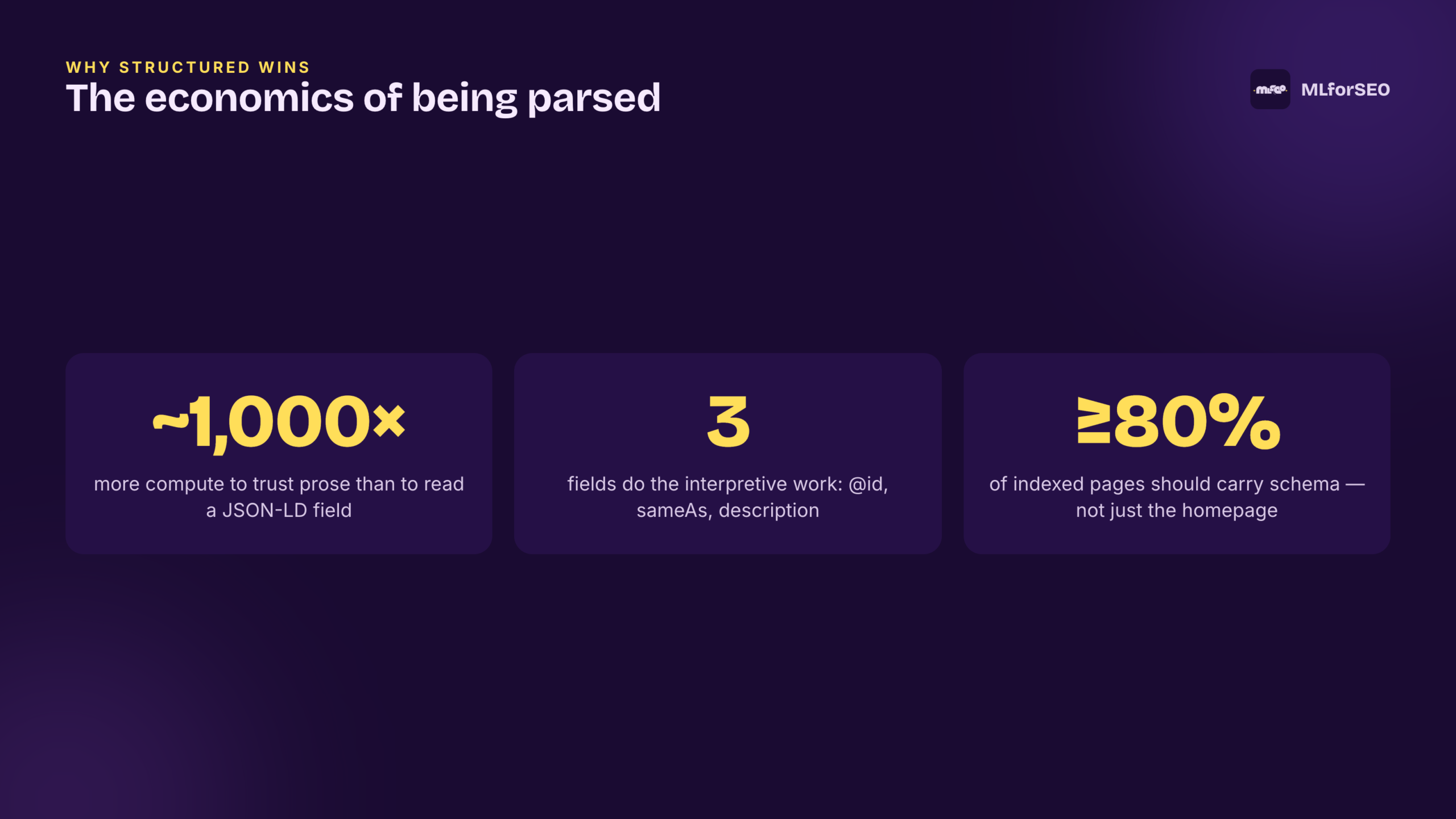
Beatrice's framing is that NLP comprehends (a probabilistic reading, right most of the time) while schema defines (a typed value, parsed identically every time) — and they are not substitutes. There is also a hard economic reason providers lean on structured data: extracting an attribute from prose costs on the order of 1,000× the compute of reading it from a JSON-LD field. At millions of queries a day, they choose the cheaper, verifiable source.
Consistency beats completeness
The instinct is to add fifty properties. But five correct, stable, consistent fields beat fifty where the name varies and the identifier changes page to page — contradictory signals actively lower the system's confidence in your entity. A failed corroboration signal is worse than an absent one.
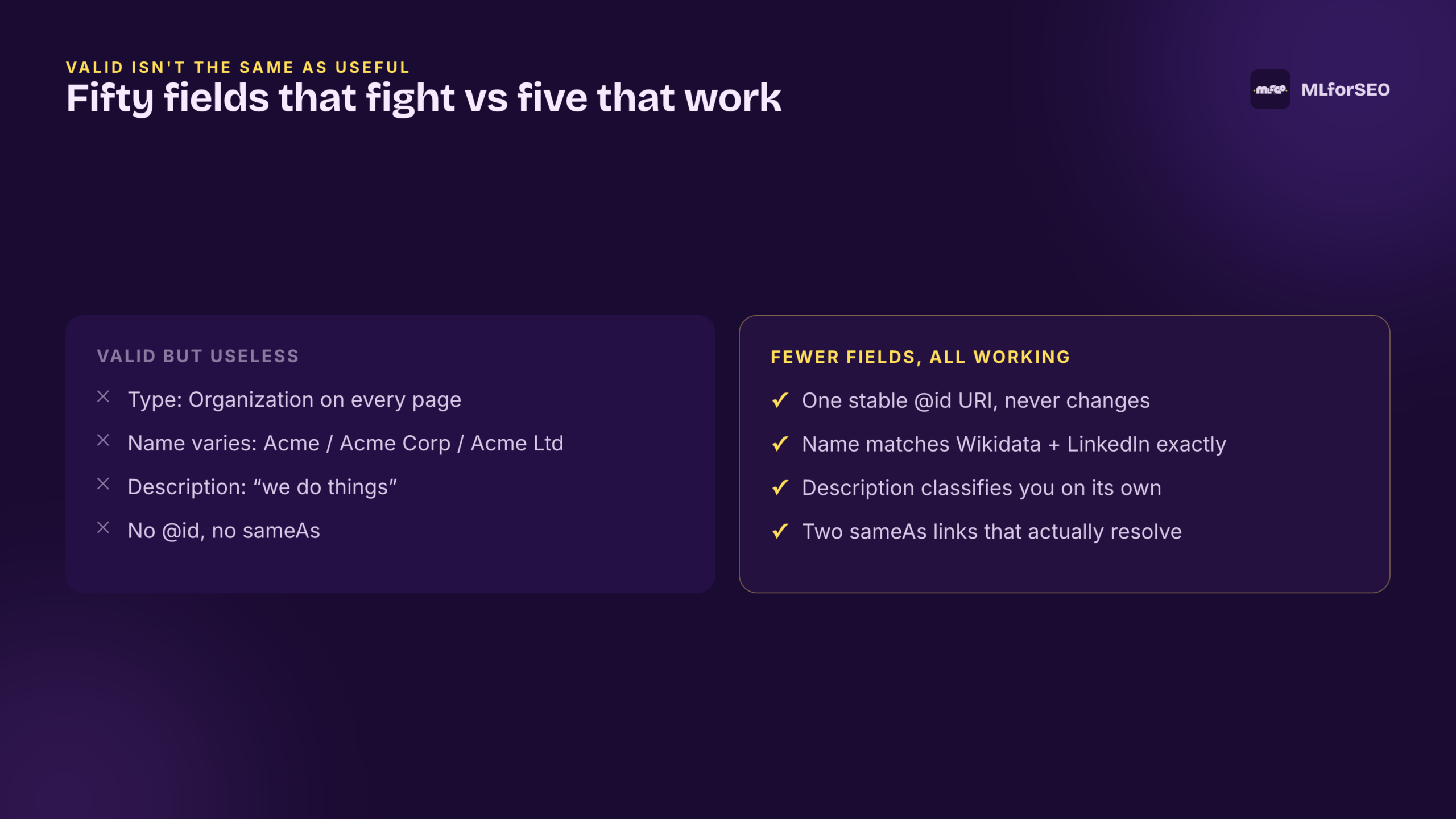
Three fields do most of the interpretive work: a stable @id URI that never changes, sameAs links that are manually verified and whose displayed name matches yours exactly, and a description specific enough to classify you even without the type declaration. And it must be server-side rendered — schema injected by JavaScript after page load is invisible to an agent doing a raw fetch, which affects a lot of plugin and theme setups. Check with View Source, not dev tools. I unpacked this here: consistency beats completeness, and the agent-audience shift here: your audience is no longer only human.
Schema removes ambiguity. It does not add authority. It should describe the verifiable record, not the aspirational one. |
The same schema is read three different ways
Where an agent meets your structured data changes what it can do with it. In search-mediated access it reads pre-indexed, already-resolved metadata (the only real risk is staleness). In direct page access it parses your raw HTML — which is exactly why JavaScript-injected schema disappears. In structured-endpoint access (a JSON-LD API, a SPARQL endpoint, an MCP server) it gets the highest-fidelity, traversable version of your graph. You needn't build the third tomorrow, but knowing the three explains why “it validated fine” and “an agent could actually use it” are different bars.
Five implementation errors show up again and again: the wrong schema type stamped on every page by the CMS; schema only on the homepage; a broken or mismatched sameAs (a failed corroboration signal, worse than none); a person with no @id (an anonymous, unreferenceable “blank node”); and aspirational schema that inflates a title your LinkedIn contradicts. Each is quiet, and each lowers confidence. The name problem is the most common: if you appear as “Acme”, “Acme Corp” and “Acme Corporation” across your own site, the resolver may treat you as three entities and split whatever authority you have earned.
There is a precision reason this pays off. A named entity in prose is just a string the system has to disambiguate — “Mercury” could be the planet, the element or the messenger god — and even on clean data, entity recognition tops out around 95%. A URI (a sameAs pointing to the right Wikidata entry) resolves that ambiguity at the declaration layer with 100% accuracy, before any inference is attempted. That five-point gap is the difference between being confidently understood and being occasionally mistaken for someone else. Schema never manufactures authority you have not earned — but it removes the ambiguity that stops a system from using the authority you do have.
This is also where search stops and action begins. A new protocol stack is arriving — WebMCP for browser-layer actions, and agentic-commerce standards from the likes of OpenAI, Stripe, Google and Shopify — that lets agents not just recommend you but transact with you. Every one of them assumes the same precondition: structured, verifiable entity and attribute data. Get this layer right now and you are not only readable today, you are eligible for what comes next. Skip it and you are invisible to both.
|
✎ Exercise 1 — the 30-minute schema audit
- On your homepage use View Source (not dev tools) and find your Organization JSON-LD. Not in the raw HTML? Agents doing a direct fetch can't see it.
- Check three things: a stable @id; every sameAs resolves to a page whose name matches yours character-for-character; the description classifies you without the type.
- Pick one canonical brand name and make it identical everywhere — schema, prose, LinkedIn, Crunchbase.
- Repeat the check on a blog post and a product page — schema should sit on ≥80% of indexed pages, not just the homepage.
|
|
✎ Exercise 2 — write a non-human ICP
- Pick the agent that matters most to you: research, recommendation, or action.
- Write its goal in one sentence (e.g. “find SOC 2-certified vendors serving the EU with public pricing”).
- List the disqualifiers — the 3–5 structured fields whose absence removes you from the shortlist.
- Check each against your current schema and fix the missing ones this week. That short list is your build order.
|
Structured data and entities are deep enough to be their own discipline. Beatrice teaches the full entity and knowledge-graph system in a companion course — AI Search, LLMs, Entity SEO & Knowledge Graph Strategies — while the agentic course shows exactly where it plugs into the pipeline.
Next week, the final edition: trust, authority, and how to become the answer the AI prefers.
— Lazarina
P.S. The fastest win most sites have is the boring one — the same founding date and legal name, identical across every page and profile. Contradictions cost you more than gaps do.
|