|
Hi there,
This is the last edition, and it ties the rest together. You can be readable, well-structured and perfectly marked up, and still not be chosen — because the system doesn't yet trust your claims. So how does a machine decide whether to believe you?
Trust is computed, not declared
Here is the part people find surprising: there is no schema property for trustworthiness, and that is by design. Self-declared trust is evidence of nothing. Instead a system infers credibility as a probability from signals it collects across independent sources, in three categories: structural (your schema, IDs, sameAs), corroboration (third parties independently confirming your name, role and facts — the heaviest weight), and behavioural (a consistent publication history on a topic). Confidence rises when all three agree and falls when they conflict.
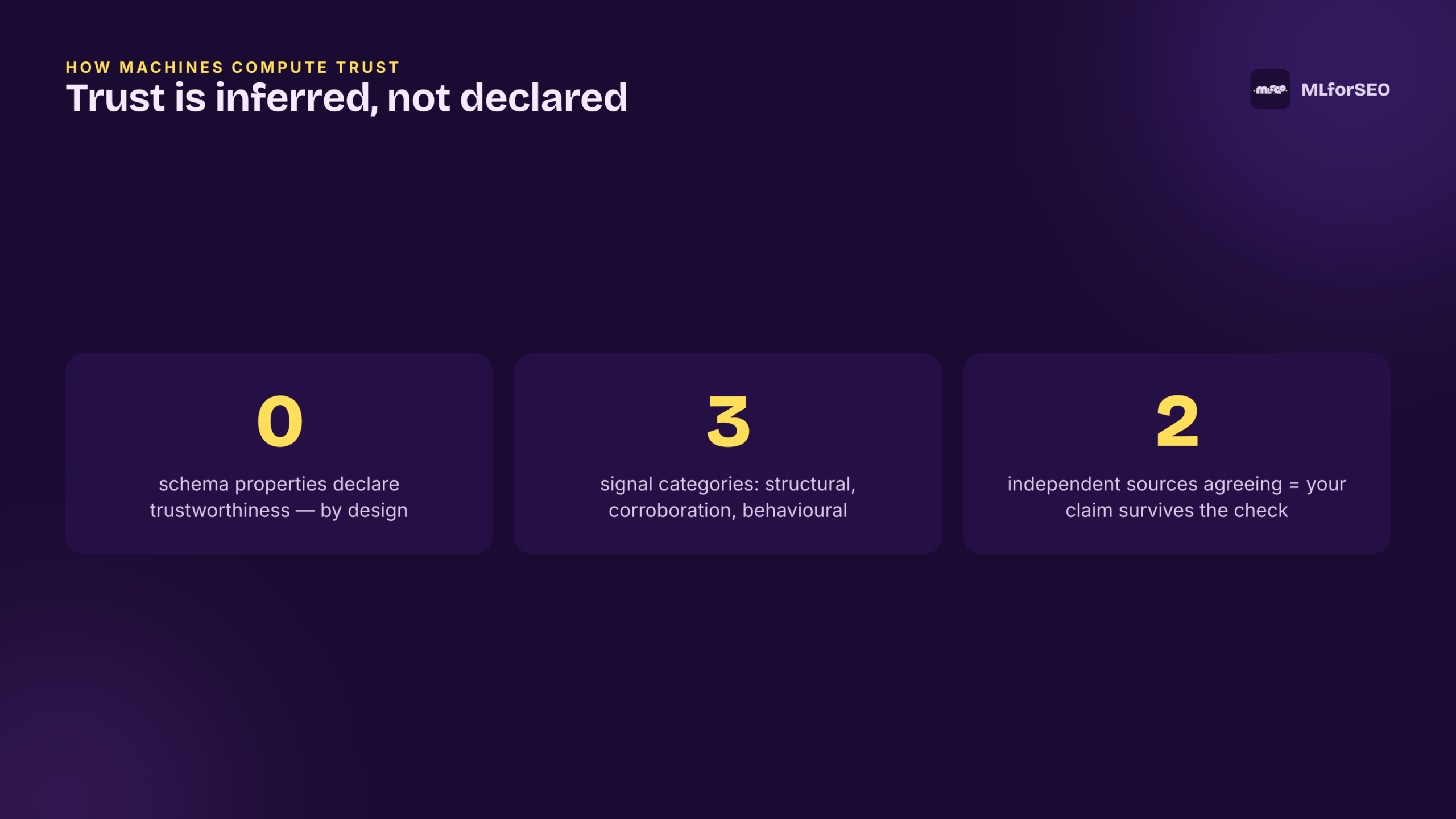
This maps cleanly onto E-E-A-T, but it is more literal than the acronym suggests. Writing “industry-leading expert” in your own markup tells the system nothing verifiable. A conference programme, a trade-press citation, a matching Wikidata entry each tell it something, because they are things other people said. What you claim about yourself is weighted far below what independent sources claim about you. Full breakdown here: trust isn't a schema field.
Depth of corroboration beats breadth of declaration. Accuracy is not sufficient — corroborated accuracy is what survives the cross-check. |
How you become the preferred answer
At the moment of answering, an agent assembles several sources in one session and checks whether they agree. Two independent sources confirming your price or your founding date — your claim survives with high confidence. An uncorroborated self-claim — qualified or dropped.
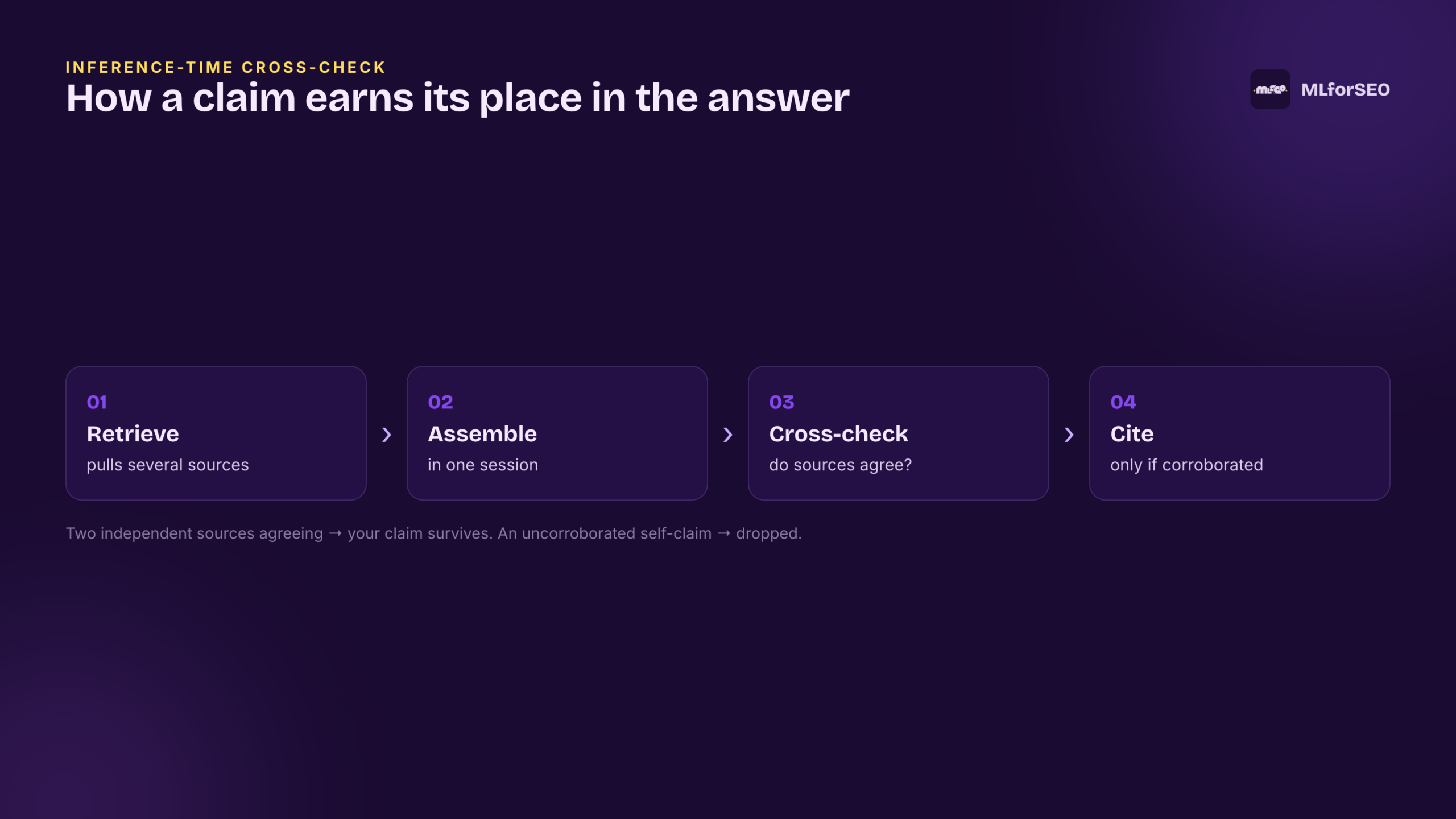
Two further rules follow. Authority is per-topic and doesn't transfer — being known for one subject buys you nothing on a new one, and three deep topic trails beat fifteen shallow ones. And contradictions cost more than gaps: if your own pages disagree on a founding date or an employee count, the system can't resolve which is right and drops the attribute from high-confidence status entirely. Becoming “the answer” isn't a trick — it is being the specific, consistent, externally-corroborated source for a claim your buyer cares about. And because entity confidence moves 4–8 weeks ahead of citations, the work you do now shows up in answers later; more on measuring that lead here: dark AI traffic.
A single organisation can hold four different authority levels at once. Beatrice's worked example: high confidence on semantic SEO (years of history, conference records, a Wikidata entity, third-party citations), medium on AI-in-marketing (a couple of years, some mentions), low on sustainability (a few articles, nobody else citing them) and zero on cryptocurrency (no trail at all — treated as a brand-new entrant). Prestige in one column buys nothing in the next. If you want to be cited on a topic, you build that topic's evidence specifically.
One trap worth flagging, because it is invisible in analytics: a site migration. A 301 redirect moves your page traffic, but it does not transfer entity authority — the graph ruptures at the ID URI. In one example an established entity's Knowledge Graph score fell from around 2,400 to 18 after a migration and took months of re-corroboration to rebuild. If you ever move domains, add “update Wikidata, external profiles and sameAs at go-live” to the checklist and watch the Knowledge Graph score from day one.
Put simply: stop spending on adjectives about yourself and start spending on the corroboration those adjectives are supposed to stand for. The system is not reading your confidence — it is counting who agrees with you.
|
✎ Exercise 1 — the corroboration test
- List your 3 most important factual claims (price, ideal use-case, company size, founding year).
- Search each and count the independent, non-promotional sources confirming the exact value.
- Zero independent confirmations? That claim will be qualified or dropped in an AI answer even if it is completely true.
- Fix contradictions first: one legal name, one founding date in ISO format, identical across your site, LinkedIn, Crunchbase and Wikidata.
|
|
✎ Exercise 2 — build one topic's corroboration trail
- Choose the single topic you most want to be cited for.
- List where credibility could be corroborated: a conference talk with a public programme, a trade-press mention, an industry database, a Wikidata entity, an authored guest piece.
- Pick the two most realistic in the next 90 days and start them — corroboration has to exist before the query fires; it can't be rushed at answer time.
- Log your Knowledge Graph API result score today and re-check monthly as a leading indicator.
|
If this series was useful, the course is the whole system
Across five editions we've covered the shift, content, infrastructure, structured data and trust — the outline of what Beatrice teaches in full in AI Search Optimisation & Agentic SEO: the diagnostics, the audits, the measurement stack and the worked examples that turn all of this into a repeatable process.
Two ways to go deeper, depending on where you are:
-
Already an Academy student? Use your member code Community30 for 30% off your next course or bundle at checkout.
-
New to the Academy? You don't need a code — the bundles on the site are already discounted. Beatrice's two-course AI-search bundle, or the three-course bundle that adds the ML and keyword-research courses, save you up to €200 versus buying separately.
Thanks for reading this series. Come and continue it with us in the MLforSEO community — that's where Beatrice and I answer the implementation questions.
— Lazarina
P.S. Not sure which to pick? Browse all the courses and bundles — and if you're already studying with us, Community30 applies to your next one.
|