|
The AI-powered Entity Audit
A complete, repeatable entity audit for any website. Now open, with an early-bird price of €100 until 14 November 💜
|
|
|
A complete, repeatable entity audit for any website, demonstrated on a real one. Early-bird price €100 until 14 November.
|
Hi,
I’m pleased to share that a new course is now open on the MLforSEO Academy: The AI-powered Entity Audit.
It’s the course I wish I’d had every time someone asked me to “do entity SEO”: a complete, repeatable method for measuring how search engines and AI systems understand a website, scoring it, and fixing what they get wrong.
Below is everything that’s inside, lesson by lesson, so you can decide whether it’s right for you. ↓
|
 |
|
New · Self-paced course
Entity SEO, finally measurable.
Entity optimisation has been standard advice for years, but it rarely comes with a way to check whether it worked. The course closes that gap with an audit you can run on any site: a score out of 15, a prioritised backlog of fixes, and AI-assisted systems that apply those fixes at scale. The method works for traditional search and for AI search systems alike, because both depend on understanding the same entities.
|
The scoring framework
The 5Cs of entity representation
Every site is scored on five questions about how search engines and AI systems understand it. Each is scored 0 to 3, at page and site level, for a total out of 15, and every score maps to a fix.
C1 |
Clarity · Can a machine tell what each page is about?
Is the page’s intended subject also its most prominent entity?
|
C2 |
Coverage · Are the right entities and attributes there at all?
Measured against the competitors you actually have.
|
C3 |
Consistency · Is each entity named the same way everywhere?
One brand, one name, one type, on every page.
|
C4 |
Connection · Is it linked to a known node in the graph?
Do your entities resolve to the right Knowledge Graph IDs?
|
C5 |
Corroboration · Does the rest of the web agree you exist?
Wikidata, third-party profiles and what AI systems already say.
|
|
Every lesson is demonstrated on a real, unedited site: mlforseo.com. These are some of the things the audit found, module by module: |
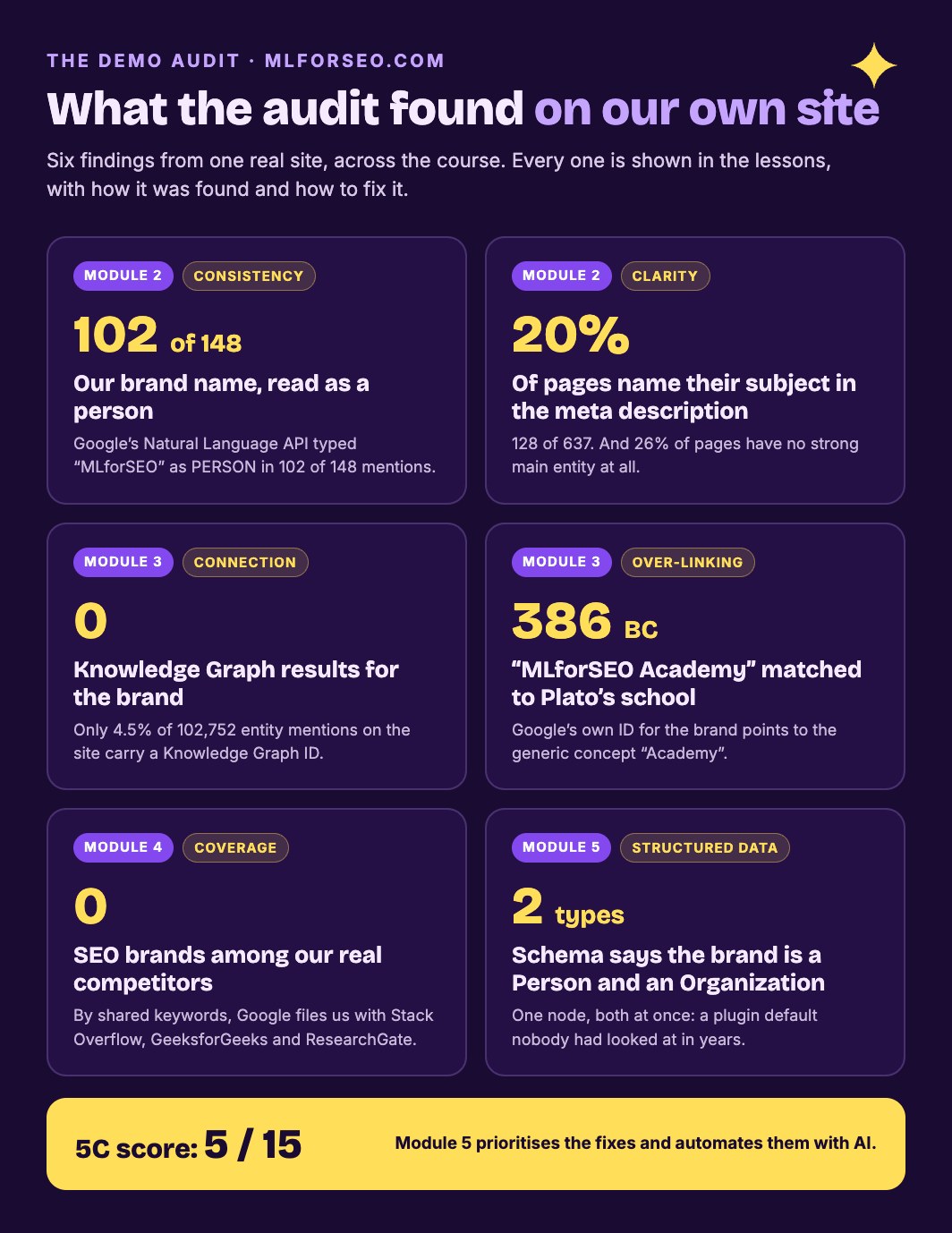 |
The site scored 5 out of 15. The course shows how each finding was made, how to rank what to fix first, and how the fixes were built and measured. |
|
Early-bird price: €100 until 14 November · prices exclude VAT · watch the first lesson free
|
|
What you’ll be able to do
|
✓ Read what a machine thinks each page is about, and find the pages whose subject isn’t the one you intended |
|
✓ Check what Google’s Knowledge Graph thinks your brand is, and whether the rest of the web agrees |
|
✓ Run a competitor gap analysis that means something, against the competitors you actually have |
|
✓ Score any site on the 5Cs of entity representation, out of 15, and turn findings into a prioritised backlog |
|
✓ Prioritise the fixes and build automated, AI-assisted systems for content rewrites, internal linking and structured data |
|
✓ Hand over a 30/60/90 roadmap and report the movement in a way a stakeholder will read |
|
Who it’s for
In-house SEOs
Measure entity work and show what moved.
|
Agency & freelance SEOs
Add a repeatable entity audit as a service.
|
Content & technical leads
Brief writers and developers with evidence.
|
Anyone asked to “do AI search”
Start from a diagnosis, not a guess.
|
You need to know SEO and be comfortable in a spreadsheet. You don’t need code or any background in NLP or knowledge graphs: every term is defined before it’s used.
|
|
Inside the course, module by module
8 modules · 48 lessons · 17 step-by-step practicals. Theory lessons explain the method; practicals walk you through running it on your own site.
|
|
Module 0
Start here
What you’ll build and who the course is for; setting up your audit stack, with the real cost at 1,000, 10,000 and 50,000 pages (most audits cost nothing); and a course map of every lesson, tool and download.
|
|
Module 1
Entity foundations for auditors
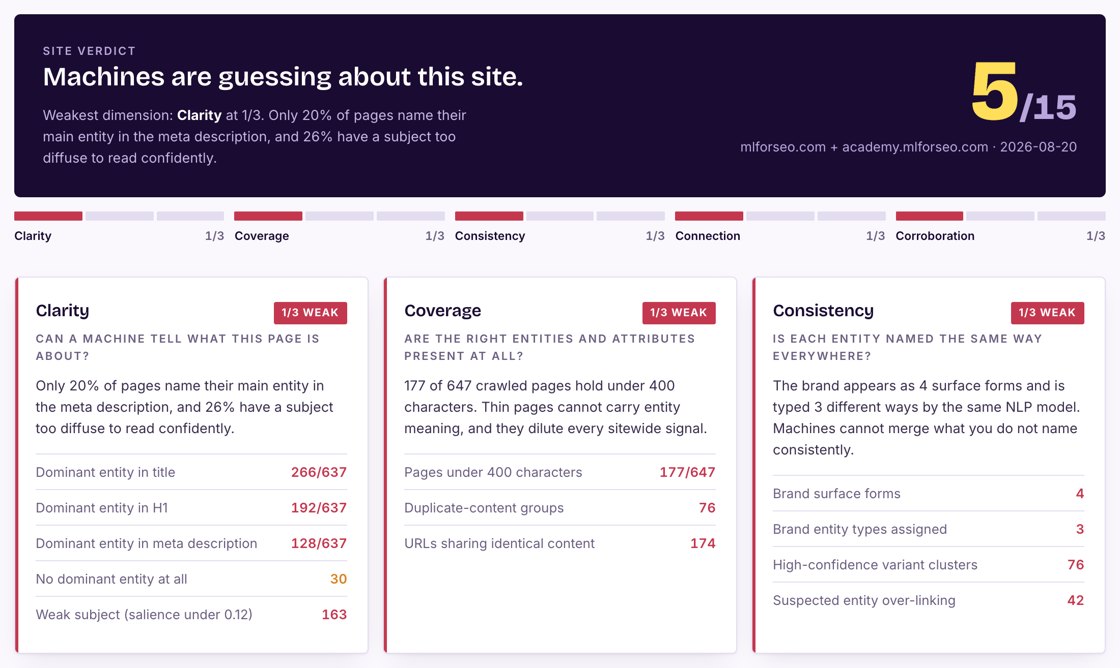
Theory. Entities, keywords and topics, and the EAV model applied to auditing. How machines decide what a page is about: salience, mentions, type and identifier, read field by field from a real API response. Then the 5C scorecard: Clarity, Coverage, Consistency, Connection and Corroboration, scored 0 to 3 each, with the demo site scored live.
PRACTICAL Scoring a site in the Entity Audit Scorecard, saving a baseline and comparing against it later.
|
 |
|
Module 2
Diagnostics: extracting the truth about your site
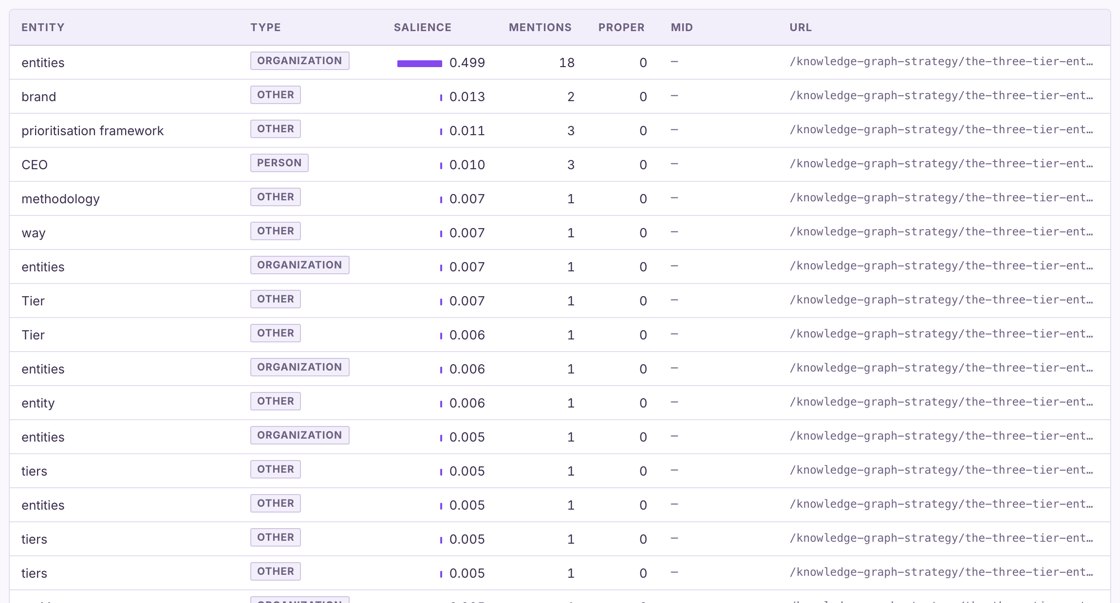
Theory. Building an audit corpus you can trust (main content only, honest sampling). Entity extraction with Google’s Natural Language API, and why the course pins version 1. Page profiles and prominence scoring: intended versus detected subject, the single most useful diagnostic. Where Claude adds something the API can’t see. And controlling cost and runtime.
PRACTICALS Custom extraction in Screaming Frog · running the crawl with Claude and the Screaming Frog MCP · from one page to the whole site in the Entity Extractor · Claude as your entity analyst, in a browser tool.
|
 |
|
Module 3
Knowledge Graph auditing & entity mapping
Theory. What Google’s Knowledge Graph can and can’t tell you. Reconciling your entities to it: matched, ambiguous and unmatched. The unreconciled entity report and choosing one canonical name. Entity over-linking, when Google resolves your brand to the wrong thing (ours resolved to the idea of an academy). And off-site corroboration: does the rest of the web agree?
PRACTICALS The Knowledge Graph Reconciler · a canonical naming table with the Consistency Checker · corroboration checks with Wikidata, profiles and a cold model test.
|
|
Module 4
Competitive entity research & gap analysis
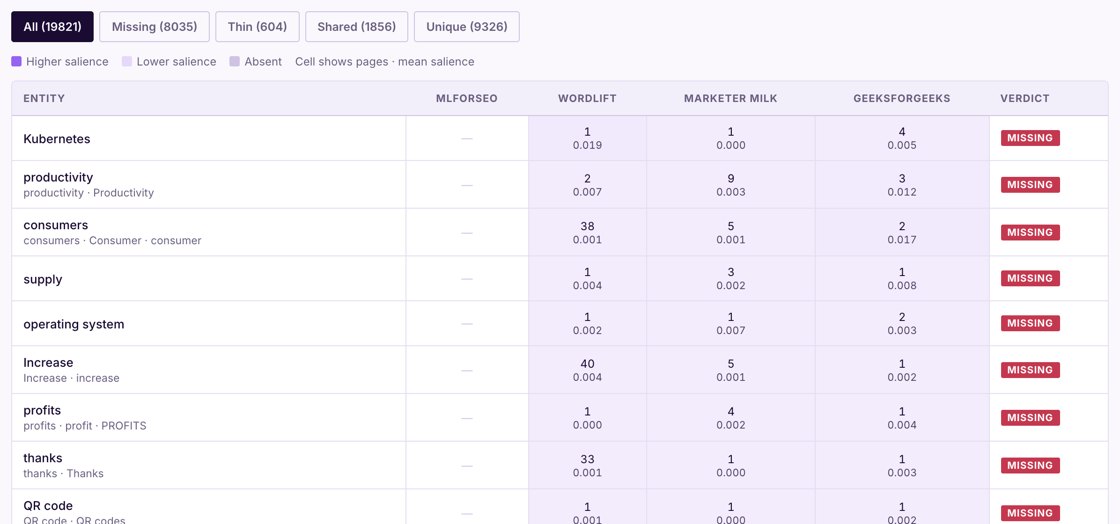
Theory. Gap analysis done properly: current versus aspirational competitors, and coverage, depth and attribute gaps. Finding your real competitors (the demo site turned out to be classified as data science, not SEO). Topic-level AI citation analysis without fooling yourself. Building the entity gap matrix, and prioritising which gaps are worth closing.
PRACTICALS Competitors with Claude and the DataForSEO MCP · AI citation analysis with settings that work, a script and a Claude skill · what a good AI visibility report looks like · removing chrome and boilerplate from competitor datasets.
|
 |
|
Module 5 · the heart of the course
Remediation: from diagnosis to automated fixes at scale
Most audits stop at a list of problems. This one doesn’t. Module 5 teaches you how to prioritise what the audit found, and how to build automated, scalable solutions with AI that fix the main issues across a whole site, with you making the calls and Claude doing the volume.
Prioritising first. The six fix patterns (disambiguation, canonical naming, attribute completion, entity-first structure, internal linking and corroboration), the research behind each, and which 5C dimension each one moves. You learn to choose the cheapest fix for a given symptom, and to start the slow external work on day one.
|
Area 1 · Lessons 5.2–5.4
Content rewriting & restructuring
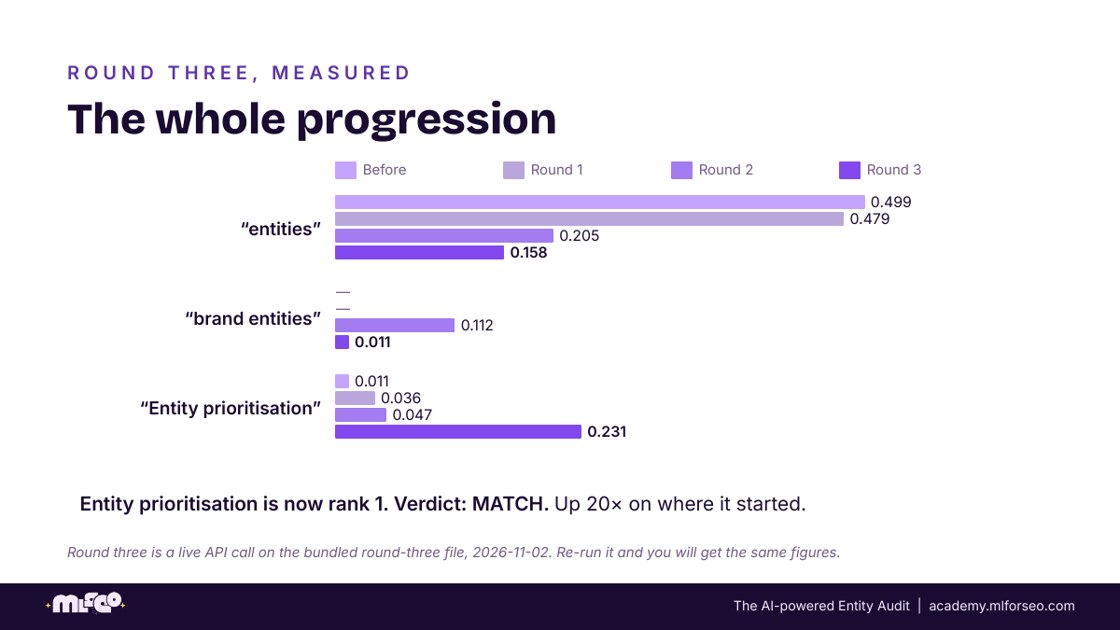
Fixing Clarity on a real page in three measured rounds, re-running extraction after each. Defining the subject rather than repeating it. Restructuring sections so they survive extraction by AI retrieval systems, which judge a chunk rather than a page, with a five-check extraction audit. Then AI-assisted rewriting from briefs built on audit data, with guardrails for facts, tone and existing rankings.
YOU BUILD entity-first meta descriptions at scale with Claude, plus an automated extraction audit and section rewrites, with proof that each fix worked.
|
From Lesson 5.2: three rounds of edits move a page’s real subject from third place to first, with salience up 20 times. You see every round, including the one that made things worse. |
Area 2 · Lesson 5.5
Internal linking & automation
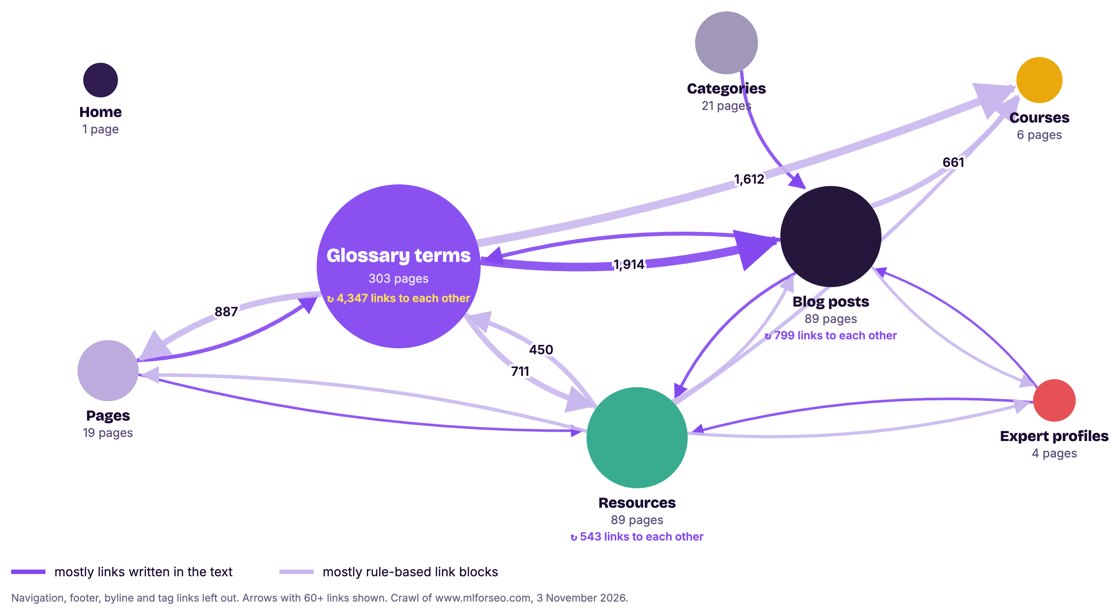
Reading the inlinks report as an entity signal. Finding link opportunities from shared prominent entities, minus the pairs already linked. Three link patterns (one-to-one, one-to-many and hub) and anchors that reinforce your canonical names. Then exactly how we built it on our own sites: render-time link rules, six link blocks, a glossary hub index and a 532-page link graph.
YOU BUILD an automated entity-linking pipeline from your audit: a link map, link rules applied site-wide, and a graph check that catches orphans.
|
Area 3 · Lesson 5.6
Structured data automation
What structured data can and can’t do for an entity, and the five properties that carry entity weight. Auditing schema against the content and against the Knowledge Graph, using the contradiction we found on our own site. Then how we built it: one entity registry, page-type builders, one owned graph per page, and a check on every deploy.
YOU BUILD JSON-LD generated from an entity registry and validated, plus a starter you can adapt for WordPress.
|
All the code is on GitHub. Want to go further? Two follow-on courses are coming: an AI-powered internal linking audit with Sam Torres, and end-to-end structured data automation with me. You can join the waitlists on mlforseo.com/courses. |
|
Module 6 · opens end of November, included
Enterprise scale
When 50,000+ pages breaks the workflow; entity pipelines in BigQuery with incremental runs and a live dashboard; and running the whole audit as an agent with Claude Code, with human review gates.
|
|
Module 7
Roadmap, reporting & next steps
Your 30/60/90 remediation roadmap, built from the demo site’s own audit, with what we fixed and measured on mlforseo.com afterwards. What to re-run, how often, and which numbers to report.
|
|
What you keep
Six free browser tools (Entity Extractor, Scorecard, Knowledge Graph Reconciler, Consistency Checker, Gap Matrix and Brief Generator) plus the Claude Entity Analyst; your API keys never leave the browser. The full demo dataset (647 pages, 102,752 entity mentions), so your numbers match the videos. The audit workbook, your prioritised backlog and roadmap, and all the code on GitHub. Lifetime access, every future update and a certificate.
|
 |
Taught by Lazarina Stoy
Founder of MLforSEO · machine learning, AI search and organic growth · author of Introduction to Machine Learning for SEO and Semantic AI-powered SEO Keyword Research
|
|
|
|
Why €100?
Not because there’s less in it: it’s 48 lessons, 17 practicals and every tool and dataset from the demo audit. As the academy grows, we want learning here to be accessible to more people, in line with the values MLforSEO was built on, and pricing is one of the ways we’re doing that.
We want more people to learn this method, because it applies to how both traditional search engines and AI search systems understand your site.
|
|
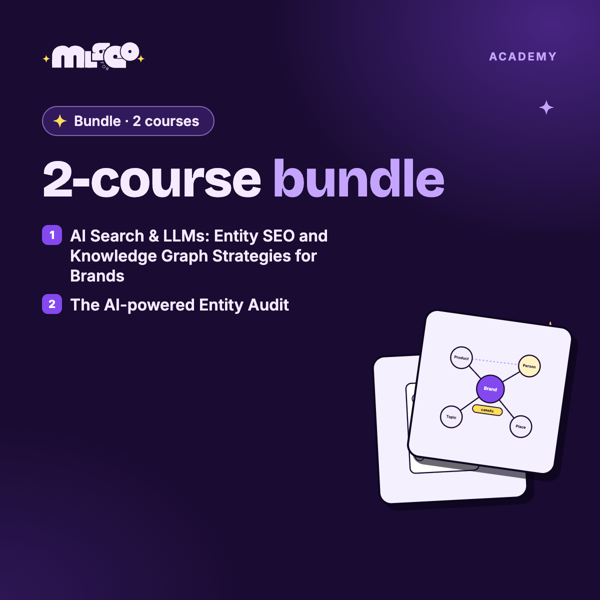
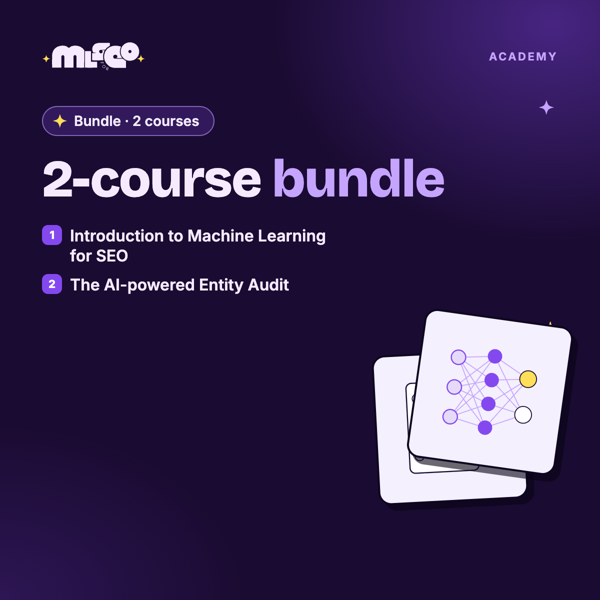
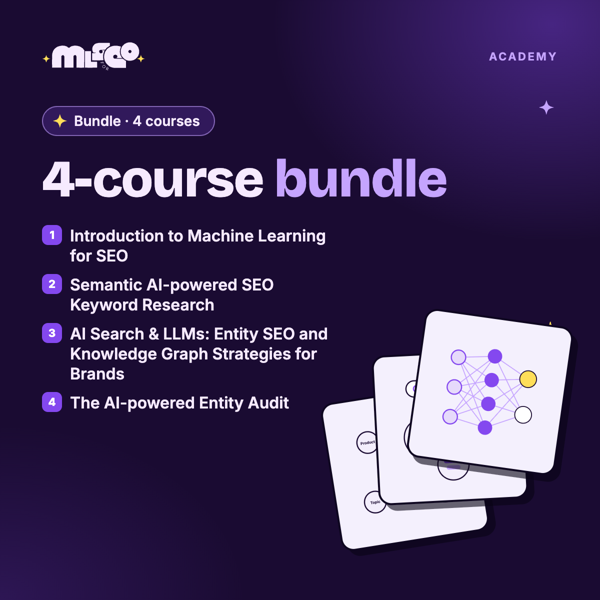
Or take it as part of a bundle
The Entity Audit pairs well with the other courses on the academy. Each bundle is priced below buying the courses one by one.
|
|
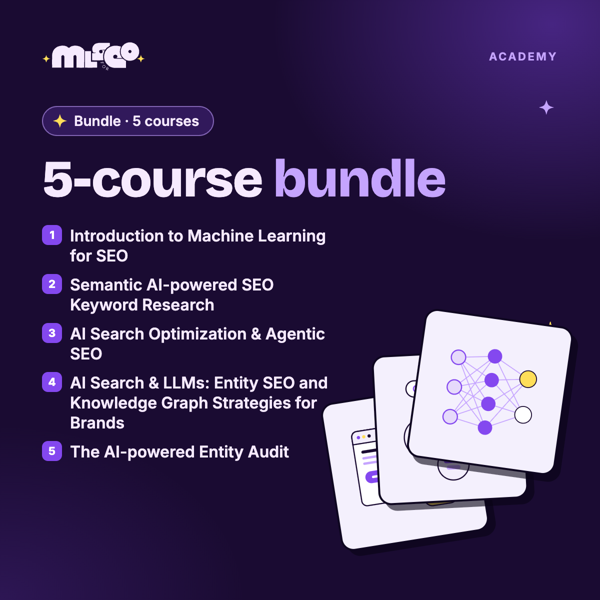 |
Every course on the academy
All five courses, in one go
€1,200
|
All bundles: mlforseo.com/courses
|
Add a 1:1 Power Hour
When you enrol in the course or any of the bundles above, you can add a 60-minute one-to-one session with me for €200 (instead of €275). Use it to review your first audit, plan an automation with Claude for your stack, or talk through what your CMS will and won’t let you do. You add a short brief at checkout and we book a time by email. Just tick “Add a 1:1 Power Hour” on the course or bundle page.
|
★ Enrolling also gives you access to the course channel in the MLforSEO Slack community, where you can bring your scorecard and questions. |
|
Like every course on the academy, this one is built on real work: every number in it comes from a real site, including the embarrassing ones. That’s exactly what you’ll find on your own sites, and your clients’.
Thank you for reading, and for trusting us with your learning.
Happy learning! ✨
Lazarina
P.S. The early-bird price of €100 is available until the end of 14 November. The first lesson is free to watch if you’d like to see the method first: watch Lesson 0.1.
|
|
|
|
|