|
Hi there,
Welcome to a five-part series on how search is actually changing — and what to do about it. Each edition takes one theme from Beatrice Gamba's new course: AI Search & Agentic SEO, explains the mechanism properly, and gives you exercises you can run on your own site the same afternoon. We start with the shift that everything else depends on.
For about twenty years the deal was simple. You got a page indexed, you worked to rank it, and a human did the rest — they saw the result, judged it, clicked, and decided. Ranking predicted value because a person sat in the middle of every search. That person has been quietly removed from a fast-growing share of searches.
Four verbs, one structural change
A traditional engine does two things: it retrieves and it ranks. Then the human evaluates (reads the options) and synthesises (combines them into an answer). When you ask ChatGPT, Perplexity or Google's AI Overviews a question, the system now does all four — retrieve, evaluate, synthesise — before you see anything. The last two verbs never described a search engine before. That single architectural change is why so much “AI SEO” advice is aimed at the wrong target.
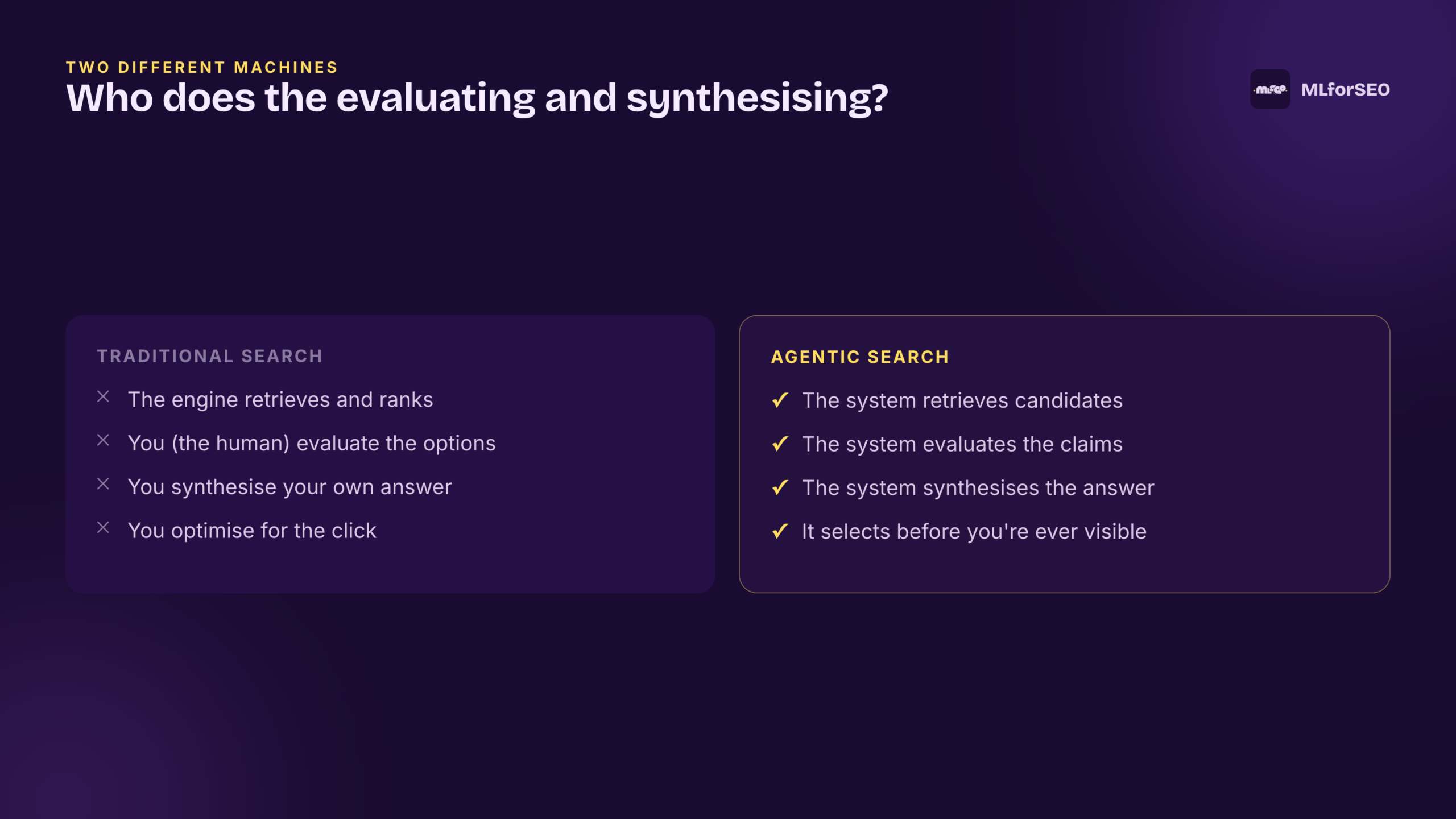
The consequence is uncomfortable but clarifying: selection now happens before visibility. By the time a user reads an answer, the system has already decided whether your content contributed a single claim to it. You never appear in a list for them to choose from — you are either selected or you are not. Being indexed is the precondition now, not the outcome.
What actually makes a system “agentic”
It helps to be precise, because not everything wearing an AI badge behaves this way. Beatrice's test is four properties, all present at once: autonomous decision-making (it picks which sources to read without a human approving each step), multi-source synthesis (it combines claims from several documents into one answer rather than handing you a list), claim-level evaluation (it judges individual statements, not whole pages), and selection before visibility (it decides what contributed before you see anything). A classic ranked list, a scripted chatbot, a Netflix-style recommender — none of these qualify, because a human still does the evaluating and synthesising.
The property that quietly rewrites SEO is claim-level evaluation. A page can rank beautifully overall and still have its specific claims ignored or overridden, because the system isn't scoring your page — it is scoring the sentence it wants to use. That is why “make the page better” is no longer precise enough advice. You improve the individual, extractable claim, one at a time.
There is a scaling effect on top of this. A single question rarely runs as one search — the system decomposes it into sub-questions and retrieves for each independently. “What's the best CRM for a small B2B team?” fans out into pricing, integrations, support quality, team-size fit and more, each with its own little contest. Your content might be the perfect answer to one of those and absent from the rest. Planning at the sub-question level, rather than the keyword level, is a large part of the new job.
Why your rank tracker looks fine while you vanish
Ranking measures visibility to a human. It does not measure whether a system selected you into a synthesised answer. Using rank tracking to judge AI-search performance is, in Beatrice's words, like using a thermometer to measure air pressure — the instrument works, it is just answering a different question. Underneath, the pipeline is brutal: it narrows millions of candidates down to a handful in stages, and roughly 99% are eliminated before a single claim is even evaluated. Position one is no guarantee you are in the answer.
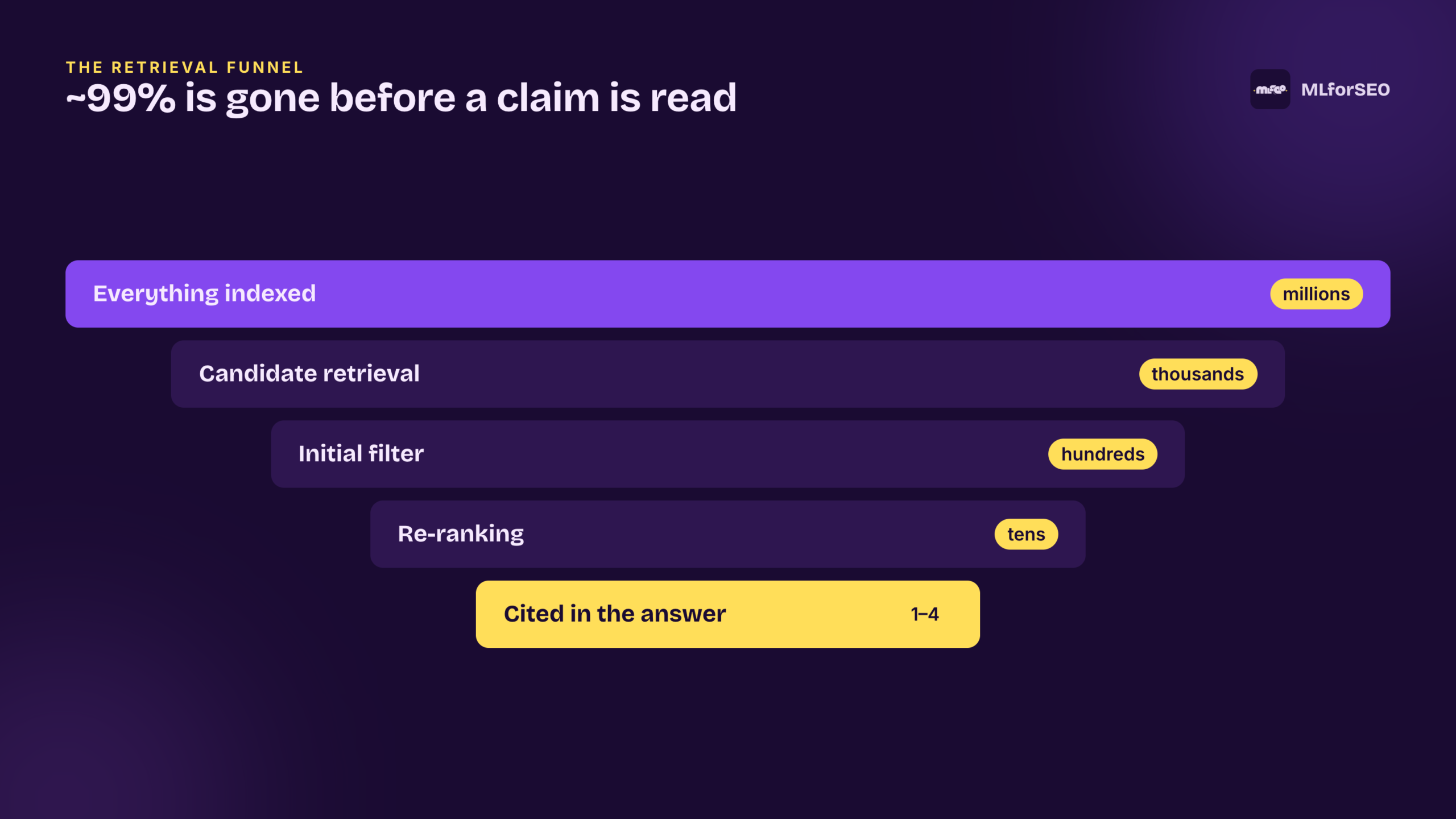
Notice what this means for the metrics you report. Impressions, average position, click-through rate — they still exist, but they have become side quests. The number that now tracks reality is your citation rate: across the questions your buyers actually ask, how often are you the source the machine used? I walk through the whole pipeline here: the five-stage retrieval funnel, and the mindset shift here: indexed is not selected.
The criteria have not evolved. They have not been adjusted. They have been replaced. |
The value has quietly decoupled from your traffic
One more idea to sit with, because it reframes what “winning” looks like. Your content can be cited in thousands of AI answers — shaping decisions, building recognition — while sending you almost no clicks. In old terms that reads like failure; in agentic terms it is the point. Usefulness has been redefined from “seen and clicked” to “selected and synthesised.” Chase the second one, and measure it, even when the first one is flat.
|
✎ Exercise 1 — the indexed-vs-selected test
- Write down 5 questions a real customer asks before buying from you.
- Ask each in ChatGPT, Perplexity and Claude.
- For each answer note two things: are you mentioned/cited, and is the claim about you accurate?
- Ignore rankings for a moment. The gap between “I rank” and “I'm cited” is your real baseline.
|
|
✎ Exercise 2 — build your test-query set
- Expand those 5 questions to 15–20, mixed across intent: ~40% informational, 30% how-to, 20% comparison, 10% “best/recommend”.
- Save them in a sheet with a column per platform and a column for the date.
- Re-run the same set on the same day each month. That repeatable list — not your rank tracker — is your AI-search scoreboard.
|
The full diagnosis — how to tell which stage of the pipeline is dropping you, and what to fix at each — is the spine of Beatrice's course. If this reframing landed, that is where it goes deep.
Next week we get practical: writing content a machine can actually use.
— Lazarina
P.S. Reply with your indexed-vs-selected gap. It is a genuinely useful number to have written down before the rest of this series builds on it.
|
